
According to a famous saying, time is money. And in a way, this is the idea embodied by the clock on Rue d’Alsace-Lorraine and the 24 numbers on its face. If you’ve ever wondered why it has such an unusual design, Toulouse Secret has the answer.
The History of Toulouse’s 24-Hour Clock
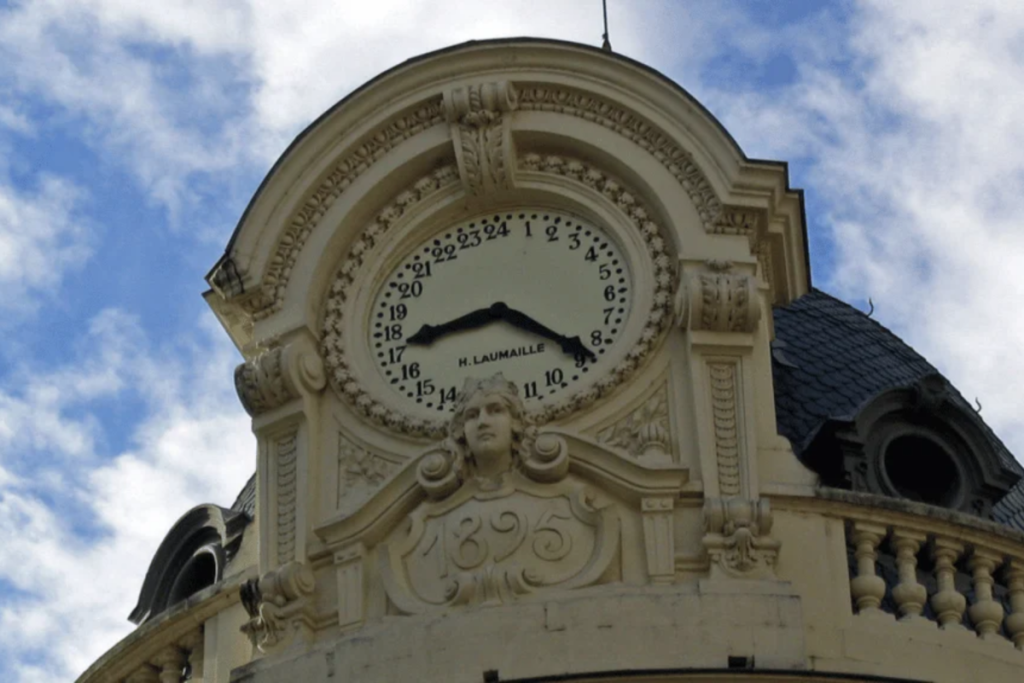
High above this beautiful Haussmann-style building, which stands proudly at 59 Rue d’Alsace-Lorraine, on the corner of Rue Rivals, you can admire a very strange clock. Like certain precision instruments used in the military, scientific, or space sectors, this one has a 24-hour face instead of the 12-hour face typically found on our watches and alarm clocks. Over the course of a day, its hour hand therefore makes a single complete revolution around the dial, rather than two.
To read it, you’ll need to adjust your habits slightly: after the number 12 come 13, 14, 15… all the way up to 24. The minute hand, on the other hand, operates in the traditional way and still completes one full rotation in an hour. It is precisely this mechanism that makes this clock so unique: according to Vincent Laumaillé, from a company specializing in monumental clockmaking, an additional wheel was added to the mechanism to slow down the rotation of the hour hand.
And if you sometimes have trouble spotting it, that’s quite understandable: the clock is installed very high up, at the level of the rotunda that forms the corner of the building. While 19th-century Toulouse residents were accustomed to looking up at the monumental clocks that marked the rhythm of daily life, today the storefronts on Rue d’Alsace-Lorraine tend to draw our gaze downward instead!
So why does Toulouse have such an unusual object?
The building itself is well worth a closer look. Built in the late 19th century, it features Haussmann-style architecture, with a richly decorated facade and an imposing corner rotunda. Its location is no coincidence either. The building was intended for commercial use from the outset and has housed banking institutions throughout its history. In the 1980s, BNP became its owner.
As for the exact reason why a 24-hour dial was chosen in 1895, it is not documented with certainty. The explanation often put forward is, however, particularly intriguing: installed on a bank building, the clock could symbolize the idea of money circulating 24 hours a day.
Jean-Henri Fabre, an architect and professor at the École nationale supérieure d’architecture de Toulouse, explained that this clock could be interpreted as a symbol of the continuity of work and the flow of money in a city then marked bythe rise of commerce and capitalism.
At the end of the 19th century, a monumental clock also served a much more practical purpose than it does today. Wristwatches were not yet in common use, and instruments for accurately telling the time were not accessible to everyone.
One of only two 24-digit clocks in France
Placed high up, the clock could thus serve as a time reference visible from the street. Its presence on one of Toulouse’s major commercial thoroughfares allowed passersby to check the time simply by looking up.
And this unusual way of displaying the hours is extremely rare. Several specialized sources list the one in Toulouse as one of only two clocks of this type still known to exist in France, the other being located in Auxerre. It’s a small piece of cultural heritage that explains why, despite its unassuming appearance, this clock continues to intrigue passersby more than a century after the building was constructed.